
Nov 22, 2019

Do you want to withdraw cash from your closely held corporation at a low tax cost? The easiest way is to distribute cash as a dividend. However, a dividend distribution isn’t tax-efficient, since it’s taxable to you to the extent of your corporation’s “earnings and profits.” But it’s not deductible by the corporation.
Different approaches
Fortunately, there are several alternative methods that may allow you to withdraw cash from a corporation while avoiding dividend treatment. Here are five ideas:
1. Capital repayments. To the extent that you’ve capitalized the corporation with debt, including amounts that you’ve advanced to the business, the corporation can repay the debt without the repayment being treated as a dividend. Additionally, interest paid on the debt can be deducted by the corporation. This assumes that the debt has been properly documented with terms that characterize debt and that the corporation doesn’t have an excessively high debt-to-equity ratio. If not, the “debt” repayment may be taxed as a dividend. If you make cash contributions to the corporation in the future, consider structuring them as debt to facilitate later withdrawals on a tax-advantaged basis.
2. Salary. Reasonable compensation that you, or family members, receive for services rendered to the corporation is deductible by the business. However, it’s also taxable to the recipient. The same rule applies to any compensation (in the form of rent) that you receive from the corporation for the use of property. In either case, the amount of compensation must be reasonable in relation to the services rendered or the value of the property provided. If it’s excessive, the excess will be nondeductible and treated as a corporate distribution.
3. Loans. You may withdraw cash from the corporation tax-free by borrowing money from it. However, to avoid having the loan characterized as a corporate distribution, it should be properly documented in a loan agreement or a note and be made on terms that are comparable to those on which an unrelated third party would lend money to you. This should include a provision for interest and principal. All interest and principal payments should be made when required under the loan terms. Also, consider the effect of the corporation’s receipt of interest income.
4. Fringe benefits. Consider obtaining the equivalent of a cash withdrawal in fringe benefits that are deductible by the corporation and not taxable to you. Examples are life insurance, certain medical benefits, disability insurance and dependent care. Most of these benefits are tax-free only if provided on a nondiscriminatory basis to other employees of the corporation. You can also establish a salary reduction plan that allows you (and other employees) to take a portion of your compensation as nontaxable benefits, rather than as taxable compensation.
5. Property sales. You can withdraw cash from the corporation by selling property to it. However, certain sales should be avoided. For example, you shouldn’t sell property to a more than 50% owned corporation at a loss, since the loss will be disallowed. And you shouldn’t sell depreciable property to a more than 50% owned corporation at a gain, since the gain will be treated as ordinary income, rather than capital gain. A sale should be on terms that are comparable to those on which an unrelated third party would purchase the property. You may need to obtain an independent appraisal to establish the property’s value.
Minimize taxes
If you’re interested in discussing any of these ideas, contact us. We can help you get the maximum out of your corporation at the minimum tax cost.
© 2019

Nov 20, 2019

Has your organization received any public or private grants to fund its growth? Grants sometimes require an independent audit by a qualified accounting firm. Here’s what grant recipients should know to help facilitate matters and ensure compliance at all levels.
Federal compliance
Federal awards require compliance with the Uniform Administrative Requirements, Cost Principles, and Audit Requirements for Federal Awards (also known as 2 CFR Part 200). This guidance requires any entity that expends $750,000 or more of federal assistance received for its operations to undergo a “single audit,” which is a rigorous, organizationwide examination.
To provide grant recipients with the latest guidance on compliance, the Office of Management and Budget (OMB) releases an annual compliance supplement. It covers compliance requirements for a dozen areas when performing a single audit:
- Activities allowed or unallowed,
- Allowable costs/cost principles,
- Cash management,
- Eligibility,
- Equipment and real property management,
- Matching, level of effort and earmarking,
- Period of performance,
- Procurement, suspension and debarment,
- Program income,
- Reporting,
- Subrecipient monitoring, and
- Special tests and provisions.
The supplement also includes sections dedicated to agency program requirements, including clusters of programs that share common compliance requirements.
Your auditor will assess whether your organization has sufficient internal controls in each of the 12 areas. To help ensure compliance, your organization should clearly document decisions and processes, as well as provide a clear audit trail of activity.
Other levels of compliance
The requirements for state, local and private sector grants vary significantly. But compliance generally hinges on the following, regardless of the source providing the funding:
- A detailed understanding of the grant’s compliance and reporting requirements,
- A mapping of requirements to individual controls and processes,
- A documented set of grant management policies and procedures that your organization publicizes and follows,
- A robust set of internal controls and mechanisms to prevent fraud, waste, and abuse,
- Training programs designed to promote grant compliance,
- Frequent risk assessments to map your organization’s policies and procedures against evolving requirements for each grant, and
- Periodic auditing in compliance with relevant guidance and statutes.
In addition, your auditor will evaluate whether your organization is willing to adapt to regulatory changes. For example, has it adopted new grant controls to accommodate best practices or legislative changes?
We can help
If juggling multiple levels of grant compliance seems overwhelming, contact us to learn how to streamline your approach. We can help your organization improve its ability to satisfy grant requirements at multiple levels.
© 2019

Nov 18, 2019

Can your business become more profitable without venturing out of its comfort zone? Of course! However, adding new products or services may not be the best way for your business — or any company — to boost profits. Bottom-line potential may lie undiscovered in your existing operations. How can you find these “hidden” profits? Dig into every facet of your organization.
Develop a profit plan
You’ve probably written and perhaps even recently revised a business plan. And you’ve no doubt developed sales and marketing plans to present to investors and bankers. But have you taken the extra step of developing a profit plan?
A profit plan outlines your company’s profit potential and sets objectives for realizing those bottom-line improvements. Following traditional profit projections based on a previous quarter’s or previous year’s performance can limit you. Why? Because when your company reaches its budgeted sales goals or exceeds them, you may feel inclined to ease up for the rest of the year. Don’t just coast past your sales goals — roar past them and keep going.
Uncover hidden profit potential by developing a profit plan that includes a continuous incentive to improve. Set your sales goals high. Even if you don’t reach them, you’ll have the incentive to continue pushing for more sales right through year end.
Ask the right questions
Among the most effective techniques for creating such a plan is to consider three critical questions. Answer them with, if necessary, brutal honesty to increase your chances of success. And pose the questions to your employees for their input, too. Their answers may reveal options you never considered. Here are the questions:
1. What does our company do best? Involve top management and brainstorm to answer this question. Identifying your core competencies should result in strategies that boost operations and uncover hidden profits.
2. What products or services should we eliminate? Nearly everyone in management has an answer to this question, but usually no one asks for it. When you lay out the tough answers on the table, you can often eliminate unprofitable activities and improve profits by adding or improving profitable ones.
3. Exactly who are our customers? You may be wasting time and money on marketing that doesn’t reach your most profitable customers. Analyzing your customers and prospects to better focus your marketing activities is a powerful way to cut waste and increase profits.
Get that shovel ready
Every business owner wishes his or her company could be more profitable, but how many undertake a concerted effort to uncover hidden profits? By pulling out that figurative shovel and digging into every aspect of your company, you may very well unearth profit opportunities your competitors are missing. We can help you conduct this self-examination, gather the data and crunch the resulting numbers.
© 2019
Nov 15, 2019

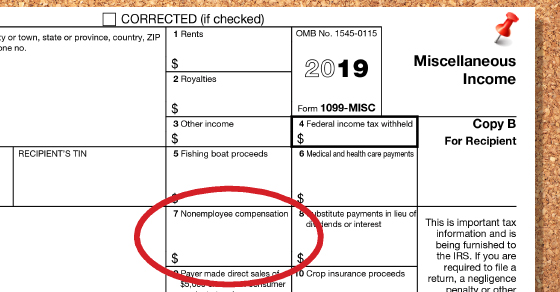
A month after the new year begins, your business may be required to comply with rules to report amounts paid to independent contractors, vendors and others. You may have to send 1099-MISC forms to those whom you pay nonemployee compensation, as well as file copies with the IRS. This task can be time consuming and there are penalties for not complying, so it’s a good idea to begin gathering information early to help ensure smooth filing.
Deadline
There are many types of 1099 forms. For example, 1099-INT is sent out to report interest income and 1099-B is used to report broker transactions and barter exchanges. Employers must provide a Form 1099-MISC for nonemployee compensation by January 31, 2020, to each noncorporate service provider who was paid at least $600 for services during 2019. (1099-MISC forms generally don’t have to be provided to corporate service providers, although there are exceptions.)
A copy of each Form 1099-MISC with payments listed in box 7 must also be filed with the IRS by January 31. “Copy A” is filed with the IRS and “Copy B” is sent to each recipient.
There are no longer any extensions for filing Form 1099-MISC late and there are penalties for late filers. The returns will be considered timely filed if postmarked on or before the due date.
A few years ago, the deadlines for some of these forms were later. But the earlier January 31 deadline for 1099-MISC was put in place to give the IRS more time to spot errors on tax returns. In addition, it makes it easier for the IRS to verify the legitimacy of returns and properly issue refunds to taxpayers who are eligible to receive them.
Gathering information
Hopefully, you’ve collected W-9 forms from independent contractors to whom you paid $600 or more this year. The information on W-9s can be used to help compile the information you need to send 1099-MISC forms to recipients and file them with the IRS. Here’s a link to the Form W-9 if you need to request contractors and vendors to fill it out: target=”_blank”>https://bit.ly/2NQvJ5O.
Form changes coming next year
In addition to payments to independent contractors and vendors, 1099-MISC forms are used to report other types of payments. As described above, Form 1099-MISC is filed to report nonemployment compensation (NEC) in box 7. There may be separate deadlines that report compensation in other boxes on the form. In other words, you may have to file some 1099-MISC forms earlier than others. But in 2020, the IRS will be requiring “Form 1099-NEC” to end confusion and complications for taxpayers. This new form will be used to report 2020 nonemployee compensation by February 1, 2021.
Help with compliance
But for nonemployee compensation for 2019, your business will still use Form 1099-MISC. If you have questions about your reporting requirements, contact us.
© 2019

Nov 13, 2019

Most businesses report financial performance using U.S. Generally Accepted Accounting Principles (GAAP). But the income-tax-basis format can save time and money for some private companies. Here’s information to help you choose the financial reporting framework that will work for your situation.
The basics
GAAP is the most common financial reporting standard in the United States. The Securities and Exchange Commission (SEC) requires public companies to follow it — they don’t have a choice. Many lenders expect large private borrowers to follow suit, because GAAP is familiar and consistent.
However, compliance with GAAP can be time-consuming and costly, depending on the level of assurance provided in the financial statements. So, some private companies opt to report financial statements using an “other comprehensive basis of accounting” (OCBOA) method. The most common OCBOA method is the tax-basis format.
Key differences
Departing from GAAP can result in significant differences in financial results. Why? GAAP is based on the principle of conservatism, which prevents companies from overstating profits and asset values. This runs contrary to what the IRS expects from for-profit businesses. Tax laws generally tend to favor accelerated gross income recognition and won’t allow taxpayers to deduct expenses until the amounts are known and other deductibility requirements have been met. So, reported profits tend to be higher under tax-basis methods than under GAAP.
There are also differences in terminology. Under GAAP, companies report revenues, expenses and net income. Conversely, tax-basis entities report gross income, deductions and taxable income. Their nontaxable items typically appear as separate line items or are disclosed in a footnote.
Capitalization and depreciation of fixed assets is another noteworthy difference. Under GAAP, the cost of a fixed asset (less its salvage value) is capitalized and systematically depreciated over its useful life. For tax purposes, fixed assets are depreciated under the Modified Accelerated Cost Recovery System (MACRS), which generally results in shorter lives than under GAAP. Salvage value isn’t subtracted for tax purposes, but Section 179 and bonus depreciation are subtracted before computing MACRS deductions.
Other reporting differences exist for inventory, pensions, leases, start-up costs and accounting for changes and errors. In addition, companies record allowances for bad debts, sales returns, inventory obsolescence and asset impairment under GAAP. But these allowances generally aren’t permitted under tax law.
Departing from GAAP
GAAP has become increasingly complex in recent years. So some companies would prefer tax-basis reporting, if it’s appropriate for financial statement users.
For example, tax-basis financials might work for a business that’s owned, operated and financed by individuals closely involved in day-to-day operations who understand its financial position. But GAAP statements typically work better if the company has unsecured debt or numerous shareholders who own minority interests. Likewise, prospective buyers may prefer to perform due diligence on GAAP financial statements — or they may be public companies that are required to follow GAAP.
Contact us
Tax-basis reporting makes sense for certain types of businesses. But for other businesses, tax-basis financial statements may result in missing or even misleading information. We can help you evaluate the pros and cons and choose the appropriate reporting framework for your situation.
© 2019

Recent Comments